Now we are at Winter Solstice, or Yule, which is the point in the year when, in the Northern half of the world, we are farthest from the Sun, and the sun appears to stand still in the sky for a few days between the 20th and 23rd December. The word ‘Yule’ is thought to have come from the Norse word ‘wheel’, the Norse people believing that the sun was a wheel that turned the seasons. It’s the longest, darkest night of the year, but far from being a gloomy occasion it is a day for joy. The wheel has turned full circle at last and from this point onward the days are getting longer. The Oak King, the God of the waxing light, triumphs once more over the Holly King who has reigned over the waning light since Summer Solstice. It is a time to honour the sun and appeal to it to re-appear, with much relief and celebration when it ascends again after mid-winter night.
Most of us will be familiar with the origin of the word ‘Christmas’ referring to the Christ child whose birth is celebrated at this time, but some will also refer to the winter solstice as Alban Arthan or, literally, The Solstice of the Little Bear - Alban meaning Solstice or possibly Light, and Arthan being the Gaelic word for small bear. The heroic King Arthur Pendragon is the ‘bear’ in question who is metaphorically reborn at winter solstice as a symbol of the light of the Divine Child.
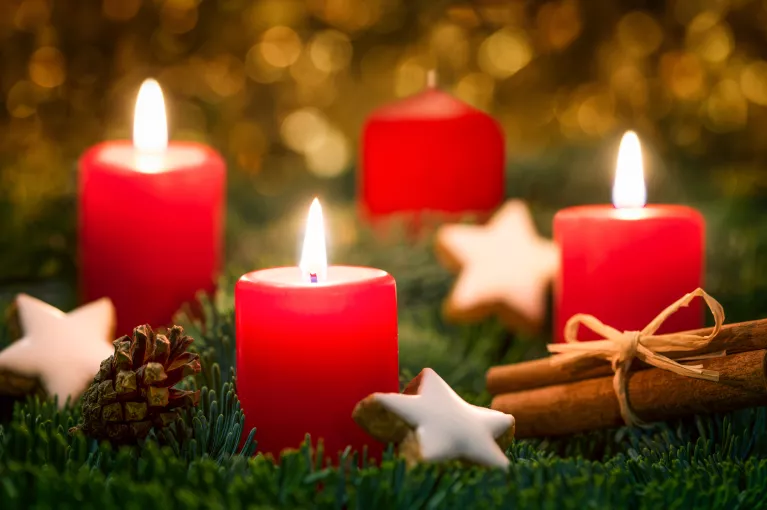
Some very old solstice traditions are still familiar to us today like bringing greenery into the house to remind us that there is still life, green and growing, even in the coldest days or representing everlasting life in the Christian tradition. Or the lighting of candles signifying Christ as ‘light of the world’ which has become a huge festival of many coloured lights to drive away the darkness.
We may yet remember the older significance of some newer traditions, like the chocolate covered Yule Log which represents the huge timber Yule Log or Yule Clog (clog being another word for piece of wood) which was kept continuously alight for 12 days and nights, burning away the old and bringing in the new light of the year.
However, some older associations to Yule have been lost, like the tradition of the Christmas ham, which probably has its origin in the Norse tradition of the Yule Boar. On Yule Eve, oaths were sworn on the bristles of the Yule Boar which was then sacrificed and eaten as a tribute to the God Freyr, God of kingship, prosperity, fair weather and good harvest, who rode a golden boar.
And some traditions we may never have come across like the Yule Goat from Sweden, where large goats are constructed out of straw, a tradition attributed to the worship of the ancient god Thor who was said to ride in a chariot pulled by goats. The similarity to Santa and his reindeer being an obvious comparison!
Many of our traditional carols and Christmas songs have elements of much earlier beliefs woven through them, including those associated with trees. Wassailing or blessing of fruit trees is one you might know from the Christmas Carol ‘Here we come a wassailing’. The Rowan tree (or Mountain Ash) with its red berries, has a Celtic association with winter solstice because of its hardiness, often growing in the highest and harshest places. It’s a potent symbol of life force energy and its message is to stay strong and not give up in hard times. Underneath a Rowan berry is a tiny 5-pointed star, an ancient symbol of protection, and Rowan foliage and berries were often used to protect doorways, churches and livestock.
Whatever the culture or traditions, winter solstice is most often marked with light, fire, feasting and celebration. It’s a time to emerge from solitariness and winter hibernation to gather together in a spirit of hopefulness and generosity, celebrating each other and being alive. It’s a chance to dance, sing and be merry, an unashamed excuse to party and play!
And yet, there is also an opportunity for stillness as the sun comes to a standstill reminding us to take a moment of quiet reflection. Maybe that moment would be on Christmas Eve, the shops are thankfully closed, deliveries received, all is finally ready and prepared and there’s a little time to breath and relax as we pause on the brink of the excitement to come. Or on the Boxing Day walk as we take to the parks and pathways coming out for fresh air after being indoors all of Christmas Day, the excitement is winding down as the digestion goes on!
Or maybe on New Year’s Eve, as we connect to another very old tradition of making New Years resolutions. Taking a few moments to reflect on the year past and what we’ve discovered in the dark dreaming of the soul since Samhain. To consider what we would like to release into the dying light of the old year, and what we would like to plant and grow in its place. Letting go with gratitude to old ideas, old habits, old feelings that no longer serve us, making way for the new. New plans, new commitments, new people, new places, new skills and knowledge, planting everything in the rich, compost that the decaying year provides.
And so, whatever this Winter Solstice brings for each of us, may the yuletide spirit and the turning of the wheel bring us love, peace and good fortune in the coming year.
Karen Jacks is a retired Occupational Therapist who has worked for the NHS for 35 years. After retiring in 2018 Karen found daily life a bit bewildering after losing the structure and rhythms that are imposed on life by working full time and having a family. She says ‘I started to look towards the more natural cycles of life, like the phases of the moon and the pattern of the seasons and that led me via lots of routes to the idea of wheel of the year, which divides the earths annual cycle into eight divisions. I have found a beautiful connection, between the wisdom and beliefs of the old ways, which are grounded in living observations of the Earth’s natural cycles, to the changes in thoughts, emotions and energy levels I experience throughout the year. It has been hugely enlightening and reassuring, in an era when everything is online and changes happen so fast, the Earths rhythms and cycles are basically the same now as they ever were’.
Karen lives in Nottinghamshire with her husband and has two grown up children. She has just started to teach Tai Ji after long years of practice and her favourite place in the world is Beresford Dale in the Peak District.
Do you have a story or experience you would like to share? From poetry to personal stories, we would love to hear from you and your experiences of nature and the National Forest. Email us at stories@nationalforest.org